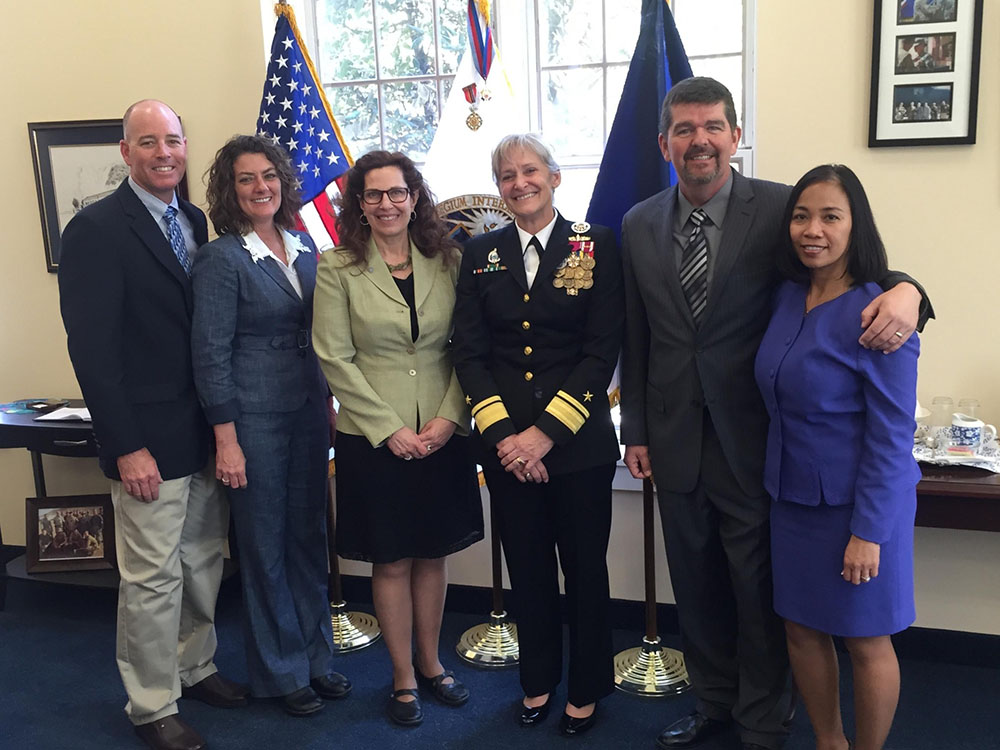
Before I make my final post, I do want to make this one disclaimer. I think we can all agree that the women that I have posted about over the past month are incredible and deserve the highest respect and our sincerest thank you for the service that they have given to our country. I do feel that I would be negligent if I didn’t point out that there are many other women that I didn’t get a chance to write about who are also absolutely amazing. Some of them are women that I know and have been privileged to work with. Some of them are women that I now have on my list because many of you have given me their names and told me a little bit about them. Some of them I don’t know much about or haven’t been able to find much information about, however I know of them (especially within the EOD community) and I know that they deserve this recognition also. I want to say that they have not been erased either and if I don’t get to some sort of project to include them, hopefully somebody else will.
There is also that second generation of women who are quickly coming up behind us who are carrying the torch forward and exceeding what we have accomplished. I’ve already mentioned a few of them, but there are more who are out there “doing the business”. A few of them I’m aware of, but many I’m not. Women like CAPT Sarah Turse an EOD Officer who has spent most of her career with Naval Special Warfare and CAPT Leslie Slootmaker who is the second EOD Officer to have command of an EOD Mobile Unit. LT Brie Coger who came up through the ranks to Chief Petty Officer before getting her commission as an EOD Officer. Navy Diver Chief Petty Officer Master Diver Melissa Nguyen, who is only the second female Master Diver and Navy Diver First Class Ashley Smith who is one of the qualified pilots for the Deep Sea Expeditionary No-Decompression Suit (DSENDS). That’s pretty cool! These and many more like them make up a very small percentage of the Diving/EOD community but their achievements continue to make up a huge contribution!
As I promised to some of you who nagged me, I’m going to brag a bit about the amazing career that I was so fortunate to have as a Navy Deep Sea Diver. I can’t begin to express how fortunate I am to have been able to serve my country for 24 years in the US Navy as a member of the Diving Community and my hope is that every young man and woman be able to have the opportunity if they so desire.
I grew up in the Midwest, graduating from Illinois State University with a Bachelor’s Degree in Biology in 1980. I jumped on my very first airplane ride to head to Newport, RI to Officer Candidate School and was commissioned in May 1981. Those were the early days for women to be allowed on ships, so I was high enough in my class (#2) to be able to select the only ship billet available to the 20 women. I headed right to Surface Warfare Officer (SWO) school before reporting to my first ship, USS CANOPUS (AS 34) in Charleston, SC as the Electrical Officer.
My tour on CANOPUS was for 3 years and as is standard for SWO Division Officers, we do 18 months in one division and then 18 months in a different division. I was drawn to the diving division but hadn’t even realized that women could become divers until I saw that there was a woman petty officer assigned to the dive locker. That was a game changer for me! After speaking with the Master Diver, who convinced me that if I really wanted something I needed to give it a try, I was able to qualify for Basic Diving Officer school. The ship sent me to Naval Diving and Salvage Training Center (NDSTC) for school and I graduated in 1983, returning to the ship as the Diving Officer, R3 Division Officer, and Navigator. This was the beginning of the rest of my career!
I left CANOPUS for shore duty and was assigned to the US Naval Academy in 1985. Initially I was assigned as an instructor in the Seamanship and Navigation department. After the first semester there, I was reassigned to be a Company Officer for the Brigade of Midshipmen for the next two years. I really ended up enjoying the time there. I needed to keep up my requalification dives though, but fortunately there was a small dive locker at the Naval Station. I had to make my requal dive with the SEAL Officer who was also assigned as a Company Officer, so you can imagine how interesting that turned out to be! (Oh, by the way, that SEAL Officer ended up becoming my husband, so it turned out okay.)
I was back to sea duty in 1987, assigned as the Operations Officer on the USS Vulcan (AR 5). VULCAN was another repair ship, although this ship supported surface ships and we made a Mediterranean deployment while I was assigned. I was still a Surface Warfare Officer, but I was in the process of trying to transfer to the Special Operations community so that I could follow a diving and salvage career path. I missed the diving, but I also wanted the opportunity to command a navy ship. For a woman at this time, there was no clear path to command of a ship as a Surface Warfare Officer, but as a Special Operations Officer, there was. In 1989 I was accepted into the Special Operations Officer (1140) community. I also screened for Executive Officer at the LT level (based on the same standards as any man).
To continue in my goal to command a navy ship I needed to stay on sea duty. I first went to Salvage school at NDSTC, then on to Perspective Executive Officer training. I was assigned as the Executive Officer on USS HOIST (ARS 40) in Little Creek, VA. Compared to the two huge repair ships that I had served on previously, the HOIST was a very small ship. She had two propellers, and she was just a joy to drive! I was totally in love with the ship and the diving was incredible also. The crew was much smaller than I was used to, and it was like a family. The HOIST ended up being the go-to salvage ship on the east coast. I think we must have ended up salvaging 3 or 4 aircraft during my tour. We also made a Mediterranean deployment. For a WWII era ship, she was able to do it all! Alas, I knew I needed to leave if I wanted command, but I almost hated to move on.
I did screen for Lieutenant Commander command (again, under the exact same standards as any of the men did) and took command of USS BOLSTER (ARS 38) in Long Beach, CA from 1992 until she was decommissioned in 1994. BOLSTER was a Naval Reserve Force ship, which meant that we did everything that the other salvage ships did, except we didn’t deploy, and we didn’t have a full crew assigned. (I have the grand distinction of being the first woman to command a Naval Reserve Force Ship, although I think that‘s pretty much splitting hairs when really Darlene’s first is the only one that counts!) We had a reserve component assigned to make up the deficit of our crew, but they were only there on one weekend a month plus two weeks per year. Don’t get me wrong, our reserve component was wonderful, I just wish we had them full time. The rest of the time, the regular crew had to make up the difference. During my command we ended up towing two decommissioned submarines from the Panama Canal to Bremerton, WA, one destroyer from San Diego to Hawaii, and one amphibious ship. We were at sea a lot! My crew was young, hardworking and amazing!
I went back to shore duty in Norfolk, VA as the Diving and Salvage Officer on the staff of Combat Logistics Group TWO in late 1994. I was the staff officer overseeing the east coast salvage ships. As much as I loved driving ships, it was a nice change of pace after 7 years of sea duty. But that calm didn’t last long. In July 1996, TWA Flight 800 leaving New York JFK airport exploded and came down into the waters off Long Island, NY. The Navy was called in to assist the National Transportation Safety Board with its investigation with recovery and salvage operations. We would end up deploying a salvage ship almost immediately, but within a few short weeks, the operations would increase in scope to the point where it became a Task Force requiring a flag officer. That flag officer was my boss, which of course meant that I was headed to Long Island as his subject matter expert in all things diving and salvage related. We would end up staying on the scene for 4 months to oversee that operation. I was incredibly lucky, I ended up having the world’s best Admiral to be assigned as the Task Force commander and learned more about leadership during those 4 months than at any other time.
Next it was time for the obligatory Washington DC tour. I got very lucky though, I was assigned to the Naval Sea Systems Command Office of the Supervisor of Salvage as the Supervisor of Diving. It doesn’t get any better than that. My whole job was to make diving better and safer for the fleet! I was also in the position to look to the future of diving and try to improve it. I had the best Master Divers, Chief Warrant Officers, and professional government civilians to work with and make this happen. I was there until 1999 when the detailer gave me another great opportunity and sent me across the river to Ft McNair to the Industrial College of the Armed Forces to earn my Master’s Degree in National Resource Management.
Now it was time to head back to sea duty, and I was beyond excited. I qualified for Commander command and was assigned to Mobile Diving and Salvage Unit TWO (MDSU 2). I was supposed to arrive in Oct 2000 for the normal change of command (CoC) ceremony with my predecessor, CAPT Phil Beierl but that didn’t quite happen as planned. Phil ended up being down in South America with a Detachment of Divers assisting a US Navy amphibious ship that was stranded on the shore. I arrived at MDSU 2 to await the CoC when the USS COLE (DDG 67) was bombed by a terrorist small boat in Yemen Harbor on Oct 12, 2000. I ended up flying to Yemen to join Detachment Alpha, who had already been in the Mediterranean Sea on deployment, to assist with the recovery of victims, the stabilizing of the ship, and the preparations of the ship to return to homeport. I ended up spending over 2 weeks with Det Alpha during the operation before I returned to Little Creek to take command of MDSU 2, while they returned to the rest of their six-month deployment.
Phil and I finally ended up having our CoC ceremony, although a much less formal affair, once we both returned to MDSU 2. It turned out to be a very busy two years. In addition to keeping the deployment rotation of having a detachment in the Mediterranean Sea for six months, MDSU 2 continued to be the lead command for the USS MONITOR Expeditions in 2001 and 2002. The expeditions ran for approximately 45 days during each summer off the coast of Cape Hatteras with mixed gas diving to 235 fsw to recover the steam engine in 2001 and the gun turret in 2002. In addition to being the Officer in Charge, I couldn’t pass up the opportunity to be a part of the historical operations from a working diver’s perspective and logged in 19 dives on MONITOR over the course of the two expeditions.
The good news from all this was that I was promoted to Captain. The bad news was that I was promoted to Captain. No more exciting operational dive billets for me. Time to start paying my dues and doing the hard stuff. I was called upon once more to take command. This time it was command of Naval Weapons Station (NWS), Earle, NJ, in Nov 2002. This was one year after 9/11. This was a huge, incredible weapons station with a long loading pier right across from Manhattan. You can imagine what the Force Protection posture was like for this facility during this time. It was also the start up for the war in Afghanistan and NWS Earle was going at max speed to get bombs and bullets to our Marines going over there. We were working 24 hours a day, 7 days a week. I didn’t have much experience with the navy civilian workforce before taking command of the NWS, but I can say that they were the hardest working people that I had met!
I left NWS Earle a little early to fill a short notice gap at EOD Group TWO as Chief Staff Officer in Little Creek in Aug 2004. The war was still going strong and EODGRU 2 was as busy as everyone else when it came to making sure that our forces were well prepared for the changes that we were encountering in this new environment. I had the opportunity to work with some of the finest while on the staff there, although my time was very short. One of the perks of being back at EODGRU 2 was that I was able to have a retirement ceremony back at MDSU 2 in the high bay in working uniform! I retired in Aug 2005 to move on with other important plans.
I retired from the navy to concentrate on my family and to do volunteer work. Most of you who know me will remember that I went home to twin two-year-old daughters when I retired, so we had more than our hands full as new parents. I also wanted to give back by working in the non-profit world but needed to find my way around it first. I would eventually do so with the Women Divers Hall of Fame, which I was inducted into in 2000 and became very involved in after retirement. I also got involved in other veteran related organizations. The Navy Diver Foundation was an excellent avenue to help with the efforts to get the Prisoner of War Medals for the SeaBee Divers from the TWA Flight 847 Hijacking in 1985. My non-profit work would eventually grow over the years into an almost full-time job if allowed, but that’s a whole other story.
I still think back upon my navy career with pride, many memories, and a complete sense of contentment. I loved what I did in the navy, I have very few regrets and I miss the comradery of my shipmates. I learned that nothing is impossible, but it takes the team to accomplish it, and each member of that team brings a different skill and responsibility to the effort. I could not have accomplished what I did in the navy without all the many people that I had the honor of working with over the 24 years that I served. All the men and women who influenced and supported me along the way were key to the person that I became. All the sailors who I worked with helped me to make things happen. I thank each and every one of them. HooYah DeepSea!
-------------------------------------------------------------------------------------------
The thoughts and words of this author are not reflections of International Training (ITI) in any way. The purpose of this text is to document and preserve the empowering stories of these women.