
Diving in Extreme Weather
by Sean Harrison:
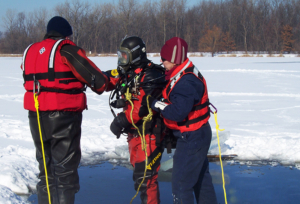 Emergency Response Diving International, ERDI, is always traveling around the world learning from public safety divers in the field. During our visits, it is interesting to see how various teams prepare for seasonal changes within their region. These changes can range from extreme to minimal. In the North American regionsthis time of year, the preparations generally focus on extreme cold and ice, whereas the southern regions focus on heavy rains and flooding. In both regions however,preparation is needed.
Teams have a wide variety of training environments at their disposal; from pool facilities to lakes, ponds, and even oceans. To simulate ice training, teams will cover one corner of a pool with a thick piece of plastic that has a hole cut into it, just like the hole that would be cut in real ice. The rest of the pool is covered in a thin sheet of plastic to simulate an overhead and darker environment. This allows the team to practice for winter calls before the first snowflake of the season falls. All the same protocols are followed including: line pulls and communications, harnesses, tie-offs, and surface support. There are even teams that have cars completely cleaned and equipped with lexan windows submerged for training. When punched, the window will drop as if the glass has been broken. They will use manikins of all shapes and sizes to simulate whatever the team may encounter, and seatbelt webbing so divers can practice cutting and freeing victims. While this is not exactly like diving on and under the ice, it works as a great refresher and gets a team thinking of all the required steps and protocols for working in these conditions. As with colder water and environmental changes, public safety responders must take into account the physiological changes too, for example, dexterity of finger movements which would decrease in these conditions. Preparing for entanglements is a necessity as first reponders must be able to free themselves in case of an entanglement. Wearing the proper personal protective equipment (PPE) as a diver, as well as tender support. Making sure to use ice rescue suits for static water conditions, as they are not intended for moving water applications.
Teams in areas where floods are expected, train for two different types of exercises: flooded homes and cars, as well as swift water. Training for stagnant flood water varies depending on location and team structure. Generally, it consists of how the team should be properly equipped, in regard to contaminated water,search patterns, and marking protocols. For areas where swift water is an issue, teams go through exercises of knot tying, finding anchor points, ropes and high lines, load bearing calculations and when not to deploy personnel into the water.
This extreme weather training, along with routine training ensures the best possible outcome for the victims, along with helping to insure the entire team comes home safe. While these extreme weather scenarios cannot be re-created for training purposes, when the time comes, these teams will be better prepared than if they had not trained at all. The hopes are that prior to an actual call-out, the team will get a chance to practice on the ice or in swift water. Unfortunately, this is not always the case. Early season ice draws unknowing victims and flash floods come without warning, hence the name. A necessary point that needs to be stressed is: every department/agency must have a solid documented SOP and SOG. This not only protects the rescuer, but also the department.
Teams all across this nation and the world provide an excellent service to the community and ERDI hopes to be able to visit as many as we can, and highlight their efforts. If you have a story about your team working in extreme weather conditions, please send it in along with any supporting photographs.
Efterlad et svar
Vil du deltage i diskussionen ?Du er velkommen til at bidrage !